Back when we were moving I stumbled on StoryGraph. Like Goodreads, it’s an app for keeping track of what you’re reading and sharing it with friends, but StoryGraph gives you a quiz when you join and recommends books for you. Most of these quizzes and algorithms don’t work on me–they always recommend famous classics I’ve already read or popular fantasy and vampire novels I’m not very interested in–and I was curious whether this one would do any better.
It was both better and worse than most I’ve seen. On the down side, about half the long list it gave me were different editions of the same few books. It recommended two or three different editions of The Turn of the Screw and The Beetle to me. On the up side, it recommended several books I hadn’t read that looked interesting, including The King in Yellow by R. W. Chambers. At least two different editions of it, in fact.
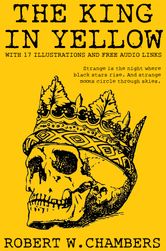
The King in Yellow is a short story collection, free on Project Gutenberg. The stories fall into three groups. The first few are in the gothic horror vein, connected by the common motif of The King in Yellow, a play which profoundly affects anyone who reads it. Some become obsessed, some become haunted or are driven to despair. The last story in this group, The Demoiselle D’Ys, is more of a fantasy in which an American hunting in Brittany is transported to a mysterious kingdom of the past. It’s never said outright, but it seems this man’s experience is the origin of the madness-inducing King in Yellow. The stories leading up to this one are kind of uneven but I enjoyed the way this one tied the others together and gave them added dimension.
The next several stories are barely stories at all. They’re extremely short and read like little prose poems or scenes waiting to have stories built around them. These were actually my favorite part of the book, and they’re short enough for me to just quote a couple for you:
The Phantom
The Phantom of the Past would go no further.
“If it is true,” she sighed, “that you find in me a friend, let us turn back together. You will forget, here, under the summer sky.”
I held her close, pleading, caressing; I seized her, white with anger, but she resisted.
“If it is true,” she sighed, “that you find in me a friend, let us turn back together.”
The Phantom of the Past would go no further.
The Sacrifice
I went into a field of flowers, whoe petals are whiter than snow and whose hearts are pure gold.
Far afield a woman cried, “I have killed him I loved!” and from a jar she poured blood upon the flowers whose petals are whiter than snow and whose hearts are pure gold.
Far afield I followed, and on the jar I read a thousand names, while from within the fresh blood bubbled to the brim.
“I have killed him I loved!” she cried. “The world’s athirst; now let it drink!” She passed, and far afield I watched her pouring blood upon the flowers whose petals are whiter than snow and whose hearts are pure gold.
The last four stories are yet again different, focusing on the romantic, bohemian lives of Parisian artists and their models/girlfriends. There are still some dramatic and dreamlike elements in these, but on the whole they’re more focused on humor and human relationships than the rest of the book. Chambers studied art in Paris in the late 1800s and I’m guessing these stories are based in part on his personal observations. I found the portrayals of artist’s models and the men’s various attitudes towards them interesting–these models seem to live in a gray area where they’re certainly not seen as respectable but they aren’t quite looked down on as common prostitutes either. Chambers showed more depth and sensitivity here than I would have expected from a man of his era.
There are definitely some odd choices in this book and some uneven writing. There are some science fiction elements that don’t work all that well, and Chambers isn’t great at writing conversation. He’ll occasionally introduce a bunch of people and not differentiate them enough to keep them straight. Still, it wasn’t difficult reading and there are also some really good ideas here, and some very human and poetic moments in the various stories. I read that H.P. Lovecraft thought The King in Yellow was great, and in Lovecraft’s work you can certainly see similar motifs of madness-inducing art and horrific echoes from the mythic past. Overall, if you’re bored on a quiet evening and like short stories, this book is worth a look.
 Oddly Cultured
Leave a comment