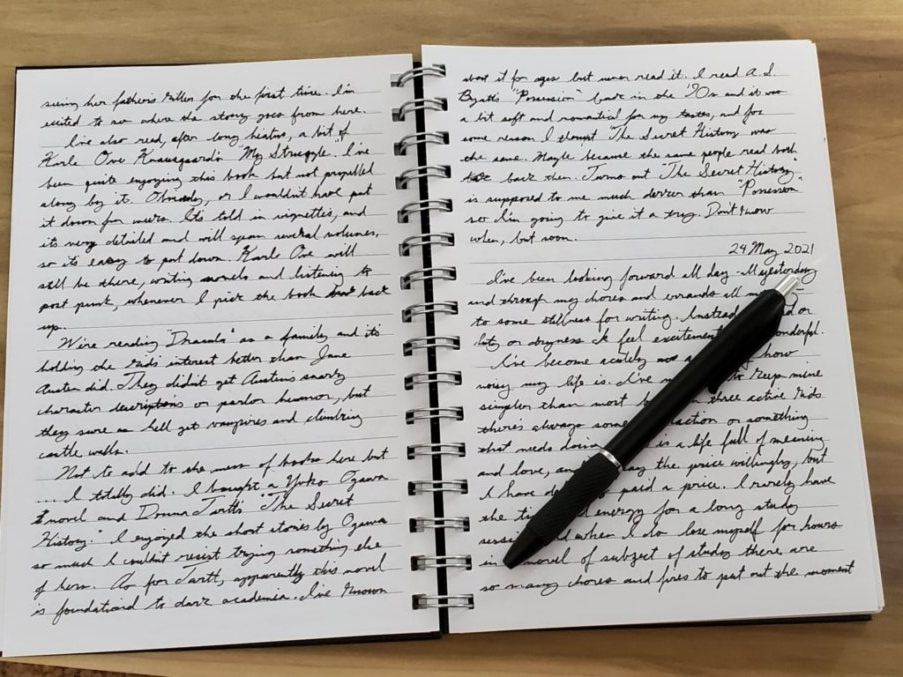
I might be part of the last generation to truly grow up using cursive handwriting. Born in 1976, cursive was a core part of my writing classes throughout elementary school, and well into high school we wrote most of our assignments in cursive. Even in college, though everyone’s papers were done with typewriter or computer, I remember grading plenty of essay tests written in cursive.
My husband, born in 1980, remembers learning cursive but never used it much. He can read cursive-based fonts on the computer easily but actual cursive handwriting is more quirky and hard for him to decipher. Since I grew up in the era of penmanship awards, I feel weirdly bad that he can’t read my handwriting. My children, still in school, learned cursive the way we all learn Roman numerals briefly, as a cultural artifact. My oldest kid learned cursive off the internet as a fancy hobby, but otherwise none of them can read or write it.
Sometimes this blows my mind. Sometimes it feels a bit sad and unreal, and sometimes it feels like I know some elegant secret skill. The practical part of me understands that nobody really needs cursive these days, and even touch typing (which I also learned in school) is becoming less important. The romantic part of me loves touch typing and writing by hand, the way famous novelists and countless Victorian ladies wrote. It’s all so very scholarly and sensual, knowing a dying art, connecting with past elegance, enjoying the feel of pen on paper as you take notes and record your thoughts.
To be honest, though, my handwriting is not great. It’s mostly because I’m left-handed. My teachers tried to adjust things for me–I remember in elementary school they’d tack huge papers to the wall at the ‘proper angle’ and there was always one tilted the other way for the poor little lefty. They didn’t adjust very well, though, and I spent a couple decades smearing my words and hooking my hand before I learned to tilt the paper waaaaay farther left than I’d been taught. Even with that problem fixed, fountain pens and calligraphy are largely beyond me. Fountain pens work beautifully for the right-handed, who gently pull their strokes as the letters unfold from left to write. We left-handers have to push our pens to make the letters, which makes it difficult to get an even stroke and a straight line. There are a few left-handed calligraphers who do amazing work, but it’s mostly a hobby for the right-handed.
I certainly don’t think great penmanship is required for a Dark Academic lifestyle. The pen still feels good in the hand and the writing can still be profoundly satisfying even if the results look like chicken scratch. And, of course, typewriters have their own romance and actually favor lefties a little bit. But I’m still mesmerized by and a bit envious of great handwriters. A few weeks ago I spent an afternoon watching videos and reading about handwriting practice, and even found some threads geared toward left-handers. I noticed most of the advice boiled down to “try a bunch of stuff until something works for you,” which is kind of what every lefty is already doing. One commenter insisted that he could only truly feel the pleasure of calligraphy after he spent years training himself to become right-handed. That’s . . . very impressive but also a bit extreme, I think. One woman had great success learning how to write upside down, which allowed her to pull her pen gracefully from right to left the way righties do. She mentioned she’d always been able to read upside down, so learning to write that way wasn’t all that hard and people (righties, mostly) were always very impressed when they watched her work.
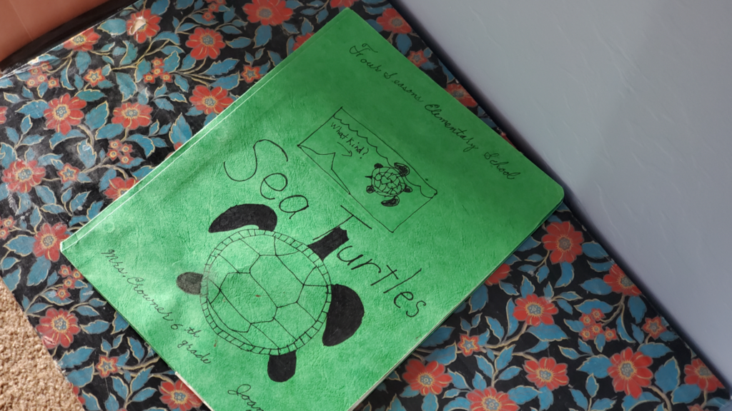
I also have always been able to read upside down, so I kept this woman’s suggestion in mind and finally tried it a few days ago. It really wasn’t that hard, though when I write this way it looks an awful lot like my childhood handwriting. Pretty amateur. I suppose my current handwriting took years to develop; if I practice for the next few years my upside down writing might be even nicer. I’m starting small with just a page or so each day in a small notebook, turning cursive and calligraphy exemplars upside down and copying them. It’s quite pleasant, listening to music or podcasts and forming letters. If you don’t already practice penmanship, I’d recommend it as a nicely Academic hobby that can be done in short bursts. You might even invest in a fountain pen or two–they’re such beautiful decor even if you only use them once in a while. I think I’ll hold off on the fountain pens, though, until my upside down writing looks less like a sixth grader’s.



 Oddly Cultured
Leave a comment