The Lost Stradivarius

The Lost Stradivarius is a gothic ghost story written by J. Meade Falkner. It’s a late Victorian novel, published in 1895. Like M. R. James, who came after him, Falkner was an academic and an antiquarian. I don’t know whether James was influenced by Falkner’s novels or whether their similarities are just a coincidence produced by similar education and personalities, but their writing styles are remarkably alike. Both authors write smooth, clean prose with a very subtle hand. Both authors focus on proper, educated gentlemen spooked by a brush with the mystical and mysterious, and prefer subtle chills to horrific thrills. But James knows to stop at the right place, leaving us with a sense of vast mysteries we’ve just barely glimpsed, while Falkner goes on and on until all the mystery is gone.
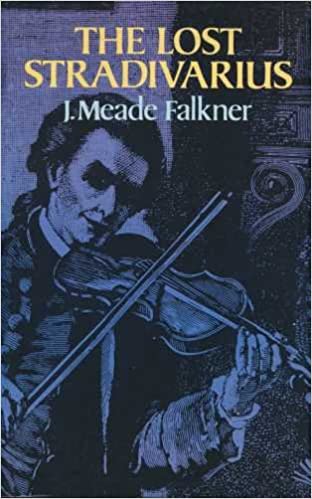
The story was so promising at the start. Sir John Maltravers and his friend Mr. Gaskell bond over music and find an Italian piece called the Areopagita that’s especially exciting, but every time they play they have the haunting feeling that someone is listening. Sir John is especially affected by this, and while playing alone one evening actually sees a ghost in his room. This leads him to discover a beautiful Stradivarius hidden away in a secret cupboard, and from that moment he begins to change. Is he literally haunted or merely becoming obsessed with the man who used to own the violin? Is this all coincidence or something more sinister?

The tension builds slowly and subtly for the first two thirds of the book. Sir John grows more obsessed and begins to waste away while his family grows more worried, while more hints of an intriguing mystery are shown us. Until this point, the story is narrated by Sir John’s sister, but the last third is narrated by Mr. Gaskell, who explains away all this delicious mystery in the most boring terms imaginable. Not to spoil a Victorian novel, but it turns out Sir John is haunted by neoplatonism.

Yup. The violin’s original owner dabbled in late Roman philosophy and mysticism and became horribly corrupted by Italian culture. Sir John found this owner’s secret diary and was also tempted by late Roman philosophy and Italian culture. Turns out the “Areopagita Suite” was a nerdy Victorian clue referring to a neoplatonist mystic. We should have known all along it was the neoplatonists!

I’m guessing you’re not terrified of neoplatonists. You might, in fact, be wondering what a neoplatonist even is? Roman philosophy does not strike fear into the modern heart. I’m not even sure it struck fear into the late Victorian heart. I’m pretty sure we’re supposed to be appalled by Sir John choosing something over the Church of England, and suspicious of his new interest in alchemy and mysticism. It’s probably the devil’s work.

At the very end, Mr. Gaskell speculates that because of all this awful neoplatonism Sir John might have tried out a forbidden mystical ceremony he couldn’t handle. This was an intriguing angle, but it was too little too late. So disappointing.

One haunted star for the smooth writing and nicely built beginning. Fine for hardcore Victorian nerds and people who hate late Roman philosophers, probably not worth it for the rest of us.

5 responses to “The Lost Stradivarius”

  1. Some of the earlier stories are motivated by ‘oh no, the pinko commie threat to our Good Imperialism, or the unwisdom of dabbling outside of the Anglican church, or the evil unleashed by those cranks that don’t eat meat! The person is actually THINKING, and that results in crime and curses!’, and this sounds like one of those. Thanks for the entertaining review. I’m not such a horror fan, but am less a fan of ‘wrong thinking done him in’–

    I hope you and yours are doing well.

    Liked by 1 person

    1. Yeah, this isn’t the first Victorian story I’ve read where thinking differently is a sign of dire evil but this was one of the silliest.

      I hope you’re doing well too in these unusual times.

      Liked by 1 person

      1. It may be the author self-preening about his clever solution. There was also such a real…oh, sense of ‘my world’ that people tried to protect, and that may have been their way. Mine is more like pretending it’s still the past or whatever in part of my world, since that time period or world meant that I was a certain person in that context–younger, with potential, or whatever it evokes in me. It was probably the same for the folks in those times–

        Yeah, thanks. It does get sort of lonely when I get stuck into studying languages online, which has been my thing recently–studying a ton of free language at duolingo, which is imperfect but helpful for review of stuff I learned in high school and also Sweedish, which I am finally learning for real. Ironic that the spouse and I each speak different languages other than English, so studying languages has not been a thing to share with others yet, which makes sense since I kind of still stink at them. I do watch some shows in Swedish on netflix, something about a blended family where nobody gets along with the new parents, which is interesting enough so far and mercifully subtitled.

        Like

      2. Yes, there could definitely be some admiration of his own cleverness, and I think you’re spot on with the idea that he’s protecting his own sense of good English way of life. When I looked up Falkner I discovered he wrote a few non-fiction works about various places in the English countryside, and I can definitely see him contrasting his ideals of English country life with a Continental life he sees as too sensual and corrupting.

        Even though this book wasn’t my favorite example, I’m fascinated by this Victorian paradox that as the empire grew and grew, Victorian people often felt smaller and smaller as they became more aware of so many other rich cultures and histories. It’s so interesting to see what they saw as shocking or scary, and how some of it seems so quaint and silly while some is even more relevant to our modern world.

        That’s so cool that you’re learning Swedish. I really need to get back to practicing Latin on Duolingo, myself. Maybe I should brush up on my Spanish, too, but the kids use my Duolingo account sometimes for that and I don’t want to get too far ahead of them.

        Liked by 1 person

      3. I studied Latin in high school and college, and a bit of Greek. High school was a big language time for me–English, French, Spanish, Latin. Maybe you can start a different account for yourself there and use it for Spanish only, or do you want to keep doing the points/league thing? I am in the diamond league and used to sneer at the ratings, but they sort of sucked me in lately–

        Liked by 1 person

Leave a reply to Donnalee of Kingston NY Cancel reply