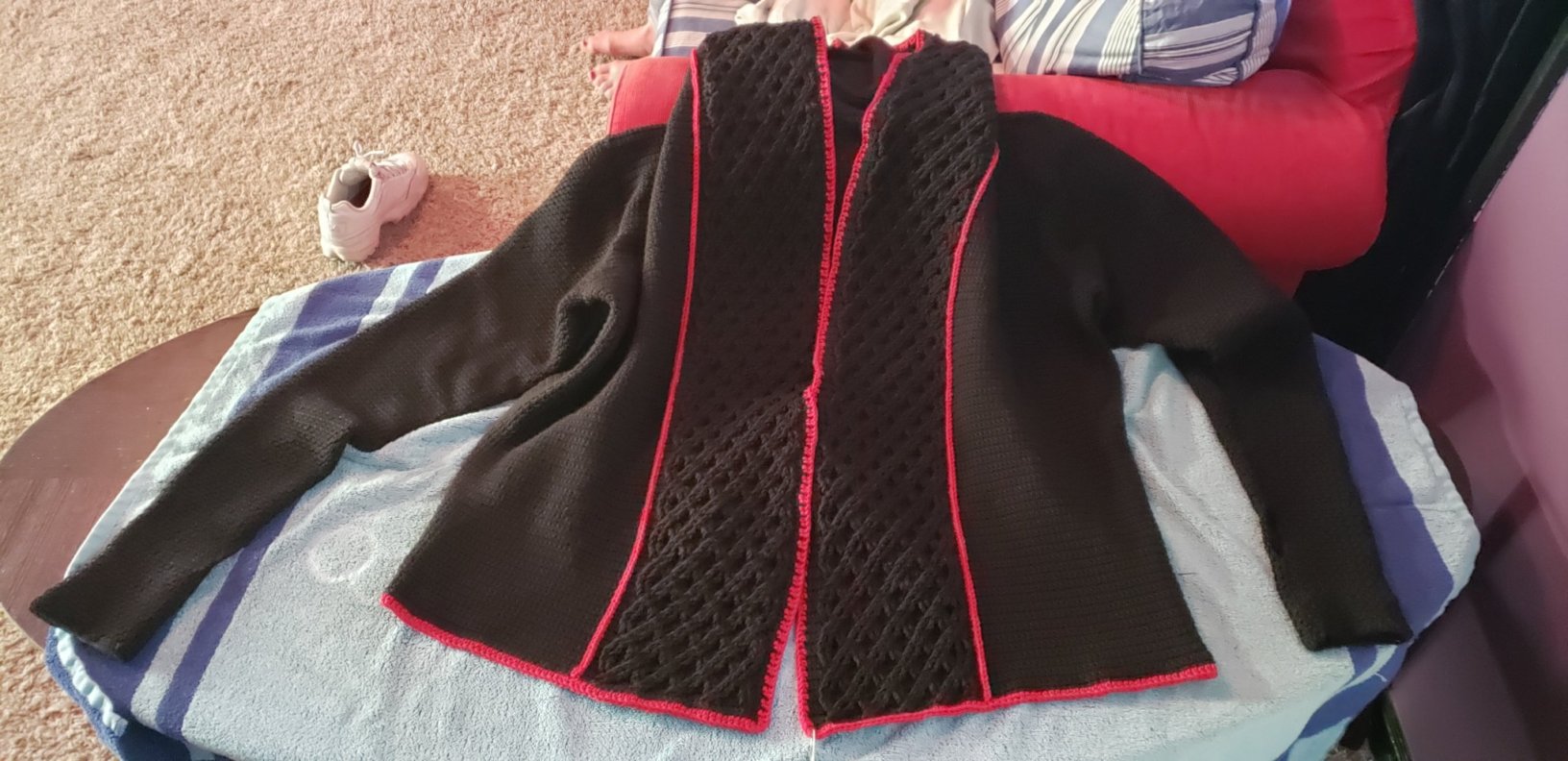
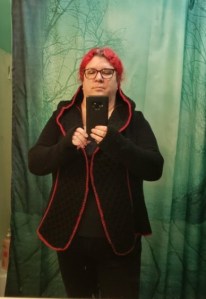
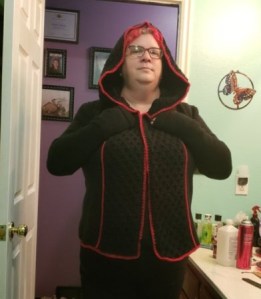
Yesterday was my birthday. We’re still on a tight budget and Coronavirus is spreading fast around here, so we kept it low key. We watched TV and ate Indian food while I put the finishing touches on the cardigan I started so long ago. Happy birthday to me!
As I painstakingly counted stitches and wove in dozens of yarn ends, I got to thinking about the politics of crochet and knitting. A lot of people were utterly surprised when Ravelry banned Trump support, but the yarn world has had a political edge for a long time. I’m no expert, I’ve never studied yarn politics formally (has anyone? I’d love to know), but I’ve experienced the warring forces my whole life.
I learned to crochet as a child. Growing up Mormon in the ’80s meant learning traditional female roles (obedient daughter, strong but submissive wife and mother) and traditional female arts and crafts. Mormons had a lot of mid-week activities back then, and along with religious lessons we learned things like cooking, canning, sewing, folding laundry, tasteful makeup and modest fashion, and yes, crochet and knitting. I realize now that some of this was part of the larger conservative backlash against ’70s second wave feminism in America. When feminism demanded financial and political power, business opportunities and leadership positions, conservative religions pushed back hard by glorifying “traditional” womanhood and doubling down on the message to stay home.
In high school I discovered feminism. Third wave feminism was just getting started back then so most of what I read at first was based on those second wave ideas my church was fighting against. According to those ’70s feminists, all that “traditional womanhood” stuff I was taught was super oppressive, including the cooking and sewing and crochet. Okay, sure. As I spent four years as one of a few dozen open feminists at my stupid religious university, I really started to see their point. Mormonism did, and still does, need a good dose of practical, action-oriented second wave feminism.
But I also noticed the third wave feminists, and I loved how they tried to reclaim some of those traditionally female arts and crafts. Sure, our grandmas and great grandmas stitched because they had to, but they also stitched as a creative outlet and a source of income, and they made wonderful useful things with their skills. Should we give up these skills just because men have not historically valued them? Probably not. In fact, it seems kind of sexist to hate knitting because it’s “women’s work.”
So cool, yarn work was back in. It’s feminist now. Maybe. I mean, a lot of male allies learned how to knit and crochet to show how woke they were. And we all know that if men do a hobby, that makes it cool. But maybe it’s sexist to wait for menfolk to make something cool. Maybe we should have recognized how cool it was all along . . . . Dammit, feminism is hard.
But seriously, I think this third wave reclamation thing is what made me pick up crochet and cross stitch again and finally learn how to knit. My relationship to feminism as a whole is rocky at times, but this part, this melding of the past and the future, has always spoken to me on a deep level. As I count those stitches, knit and purl, I’m doing what generations of women before me did. I’m showing off my skill, I’m expressing my creativity, I’m soothing myself with the feel of the yarn and the rhythmic motion of the hooks and needles the way women have done for hundreds of years. But I’m also connected to the present moment, to the explosion of new artists and crafters who knit pussy hats and crochet skulls into their shawls and design horror themed embroidery.
As the present moment changes, the designs and who’s making them changes. The community changes. When Ravelry banned pro-Trump patterns, a lot of people were shocked and surprised, but the move didn’t come out of nowhere. As feminism widened out into larger concerns about inclusion and justice, that part of the yarn world strove to become more inclusive. Many professional pattern books and magazines seem to still cater to a “traditional womanhood” audience, featuring mostly conventional white female models and pattern writers, and many parts of the community felt under-served and maybe even unwelcome. I can see why Ravelry might think it good to shift its focus to serve this part of the community better.
I often wish the internet didn’t turn everything into a full-out battle, though, and I think all sides can be guilty of this. I know from experience how much people can change over a lifetime. I have, and I’ve seen it over and over in others. Internet culture helps spread new voices and ideas at light speed but, with its ability to dig up every past mistake and wave it like a battle flag, can also make change seem pointless or even dangerous.
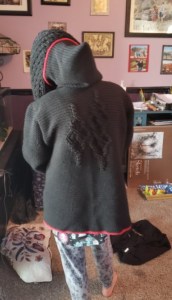
Alas, I have no solutions. I’m just rambling. No matter the politics, I’m thrilled with my sweater and already excited about my next project. When I saw this on Yards of Happiness way back in February I knew I wanted to make it. I’m a little old to be a true Harry Potter fan (I was already in high school when the first book came out), but it’s such a beautiful design and I do like the touch of magic about it. I’ll have to goth up the color scheme of course, but aside from that it’s perfect. 😉


 Oddly Cultured
Leave a reply to Donnalee of Kingston NY Cancel reply