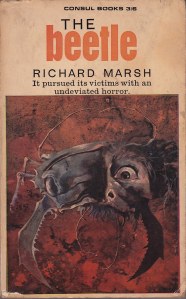
 I’ve been reading Richard Marsh’s The Beetle for the last few weeks. With restless kids underfoot, quarantine has given me less time to read than usual, but I still finished this fascinating book yesterday afternoon. This book might be most famous as “that book that came out the same year as Dracula.” Dracula is certainly the more famous book and rightly so, but The Beetle is an underappreciated gem that deserves a revival.
First, the plot. Up and coming statesman Paul Lessingham is being harassed by a mysterious and supernatural enemy bent on revenge. This enemy, a member of a secret cult dedicated to an ancient and possibly evil version of the goddess Isis, can hypnotize people and might have the ability to change shapes. Unable to get at Lessingham directly, this enemy goes after Lessingham’s friend Atherton and eventually kidnaps Lessingham’s fiance, Marjorie. The ending is kind of weak, building up to a major confrontation with the mysterious cultist and then not delivering, but most of the story is quite exciting. There’s not a lot of true horror but the story had a great sense of adventure and weirdness I really enjoyed.
The story is told from several points of view, including Atherton’s, Marjorie’s, and a poor hypnotized minion’s. I was impressed by how well-drawn and human most of the characters were; gothic and horror novels are notorious for flat characters who are either completely good or completely evil, and most of these characters were refreshingly normal. I also enjoyed the effort to speak from Marjorie’s point of view for part of the story–she came across as intelligent and brave, though totally out of her league in this adventure.
The novel’s cultist villain is never given a proper name, and even their gender isn’t clear. The villain presents as a man while in England but there’s strong evidence that Lessingham knew this person as a woman in Egypt a long time ago. The villain dresses in “Arab” robes and is sometimes referred to as an Arab but is heavily implied to be from a much older and much more mysterious lineage. There are definitely some racist colonialist attitudes displayed in this novel, but I actually find this villain really intriguing. The ambiguous gender, the false identities, the hypnotic powers and the dark images of this ancient cult are really powerful and could be updated in wonderful ways. I would love to see a modern reboot of this villain.
In the Victorian era, Britain got pretty obsessed with ancient Egyptian artifacts and myths, and this obsession made for some pretty fascinating horror themes. Britain was on top of the world, colonizing the shit out of other continents, feeling all civilized and superior. But at the same time, the British were learning about these ancient civilizations that lived and died before England was even a glimmer in King Arthur’s eye. The world was suddenly bigger and older than they’d ever imagined, and that was a scary thing. Could the great British Empire become just a collection of dig sites and myths the way ancient Egypt did? What secrets lived in these vast deserts and jungles the British were just beginning to explore? The Empire had never been bigger, but its more thoughtful citizens had never felt smaller or more insecure.I find this tension fascinating, and The Beetle explores it to great effect.
I give this novel four haunted stars. It’s got interesting themes to please the lit geeks out there and a good enough plot and characters to be fun for the more casual reader. If you’ve already read Dracula a dozen times (and what bookish goth hasn’t?), it might be time to give The Beetle a try.


 Oddly Cultured
Leave a reply to The King in Yellow – Femina Studet Cancel reply