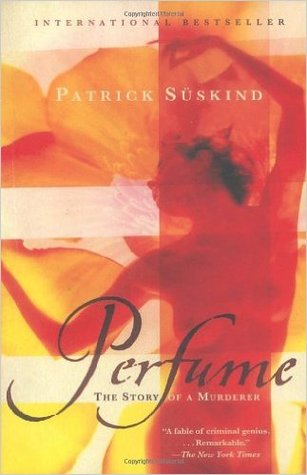
 Patrick Suskind’s Perfume is exactly like perfume. It’s an obvious comparison, almost a bad joke to say, but it is what it is. A good perfume can blend drops of flower and citrus and musk and resin into one alluring, harmonious whole. Suskind’s book blends history and fantasy and comedy and suspense into one compelling, fascinating story.
From what I’ve read about it, Suskind’s book also borrows from and imitates a whole list of German Romantic authors and French satirists. If you’ve studied German literature, which I have not, apparently you can make a game of spotting these borrowings. Critics and professors have spent some serious ink analyzing and debating this pastiche and what it means. If you’re into hardcore literary criticism it’s pretty interesting, but you’re probably not so I’ll just give you a couple links and move on. (As you can guess by now, the book was originally in German, and my copy was translated into English by John E. Woods. I read Suskind was very particular about translation quality, and I have no complaints to make about this one.)
You don’t have to be a hardcore lit geek to enjoy this book anyway. It would be neat to know all the older works Suskind stole from, but it’s completely unnecessary. The style is very readable and there’s plenty of fun to be found in the sights and smells of 18th century France, the parody of enlightenment “scientific” exploration, and the murderous supernatural tale of the scentless Grenouille’s quest to create a perfume that will make the world love him.
I really liked the focus on scent–it’s an unusual focus that really brought me into the story. Scent connects to our emotions and memories so easily that even reading about it made the story feel more intense and personal. The rich descriptions of scent help us see (smell) the world the way Grenouille does, but it also highlights how inhuman he is. He has no scent himself, and because of that he’s not really part of the world. He understands all the world’s deepest unconscious secrets but he can’t actually connect to anyone or anything.
Grenouille’s story is fantastical and dreamlike, more myth than biography. In a way, it’s everything I had hoped Vathek would be, so it’s a lucky chance I picked this up right after Vathek. Both stories blend dark comedy with horror, both show men destroyed by their pursuit of forbidden mysteries, both rely heavily on occult and supernatural elements. But Perfume is much more carefully and beautifully written, and wisely leaves out Vathek’s old-timey exoticism.
I highly recommend this book. You can enjoy it on many levels: as a smooth modern take on the gothic romance, as a slowly building crime story, as a rich brew of symbols and themes, as a commentary on the creative process itself. I give it 5 haunted stars.


It seems only right that I read E.T.A. Hoffmann’s The Devil’s Elixirs next–I clearly need to read more German literature.


 Oddly Cultured
Leave a reply to Corvus Chao Cancel reply