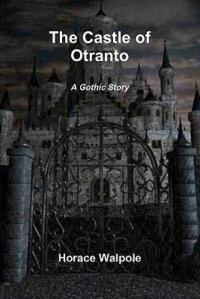
 Thanks to the internet, you can get online versions of The Castle of Otranto, by Horace Walpole, for free or cheap from a number of places. If you prefer books on paper, it’s famous enough to be found in public libraries (my library has a copy) and you can buy paperback versions pretty cheaply.
If you’ve read a few 18th or 19th century novels, you know their usual style. Lots of big words, long descriptions of rooms and landscapes, lots of dramatic declarations of love and virtue. Otranto mostly follows this pattern. I went in expecting some flowery prose, and was not surprised to find lots of sentences like this: “Matilda, who doted on her mother, smothered her own grief and amazement, and thought of nothing but assisting and comforting her afflicted parent. ” I find the style charming when I’m in the mood, and the constant talk of deep piety and passionate but virtuous love is very sweet and adds to the Romantic drama. But long descriptive passages can put me to sleep, so I was delighted that Otranto got right to the action and kept the excitement up pretty constantly throughout. Otranto is a great introduction to gothic novels. It’s really dramatic, has all the ghosts and knights and tragedy you could hope for, and it’s a really quick read.
The plot centers on Manfred, the cursed Prince of Otranto, and his family. The book begins as his hopes and dreams begin to literally crash down around him. In the process the Prince does some pretty awful things and by the end I was quite moved by the plight of his wife and daughter. In a modern novel I’d want to slap them into action, but as medieval women with little education and very few options in life they made moving tragic figures, hoping against hope that Manfred would come to his senses while not having power to do much but plead and pray.
Otranto was written long before the “psychological novel” became popular, and stories of this time often have fairly flat characters, so I was pleasantly surprised that Manfred had a little depth and internal struggle going on. Gothic novels get slammed sometimes for their unbelievable plots and supernatural elements, but they often have an emotional depth and range that other novels of the time lack. It’s one of the things that attracts me to them, and it’s probably what attracted the original readers as well.
Considered the first gothic novel, Otranto introduced the creepy medieval castle trope (which over time morphed into the creepy Victorian mansion trope) but the castle here is more of a backdrop to the general medieval theme. Later gothic novels made their castles and mansions much more vital to the plot and atmosphere, adding creepy locked rooms and secret passages, but Otranto is a pretty standard prince’s house. The castle is far less important than the ghosts appearing in it, and the ghosts are excellently creepy and portentious. In this way he’s almost the opposite of Ann Radcliffe, whose novels are full of dungeons and locked rooms and secret passages, but whose ghosts are always revealed to have natural explanations. I’m eager to read a few other original gothic authors and see where they fall on this spectrum.
Overall, I would recommend this book to anyone looking to dip a toe into the old gothic classics. It’s a great place to start, both for historical value and for being an easy, fun read. I chose this to restart my challenge mostly because it had been on my kindle for months, and it was a lucky choice. It was definitely an exciting kick-off and makes me eager to dive into The Monk, by Matthew Lewis, another of the old classics.
I give this novel 4 out of 5 haunted mansions.


 Oddly Cultured
Leave a reply to The Monk: a Review – Geek Goth Grotesquerie Cancel reply