I still have one last summer book to review. Well, early fall maybe. I finished it Charles Dickens’ Great Expectations in late September. This is a really famous novel and there are dozens of good plot summaries of it so I won’t attempt my own. I’ll just share a few thoughts and impressions instead.
Is it weird that I never read Dickens in school? That seems weird, especially for someone who majored in English Lit, but I never did. Last Christmas (or maybe the one before?) we read A Christmas Carol as a family and I think I’ve read a couple short stories by Dickens but that’s it. This was my first full length Dickens experience. I still can’t decide if I want another such experience.
When I started the book I’d just finished a couple of obscure and rambling gothic novels, so Dickens’ vibrant and humorous writing was a refreshing change. For the first hundred pages or so I really enjoyed it. As the novel wore on, though, it lost some of its charm. “My God,” I’d think, “can he say nothing simply? Can’t a character just eat a biscuit or open a window without ten words of description? It’s like those word games where you’re not allowed to say what’s on the card and need to use fifteen different words until your partner guesses what you mean.” By the end I was tempted to just quit and read a summary on Wikipedia. I’m a twentieth century woman and I like my prose lean and mean. I’ve learned to appreciate the older, more flowery styles of writing but I guess I’m not quite ready to fall in love with Dickens.
I did enjoy the story, though. It was fairly complicated and wandered down several dead ends, but no more than a lot of popular Victorian novels. It was pretty heavyhanded with its moral lessons, but again no more than a lot of Victorian novels. It had a lot of vivid action and humor going for it, and I really enjoyed the fact that Pip was just a regular kid. He was selfish and short-sighted and made a lot of mistakes, and he was more relatable and realistic than a whole lot of characters from the time. In fact, even though Dickens exaggerates most of the characters for drama or comedy, many of them are relatable and have nice touches that make them feel like behind the dramatic storytelling they’re very real. And of course Dickens gets bonus points for making blacksmiths and shopkeepers into main characters instead of just sidelights to a ‘properly aristocratic’ main character.
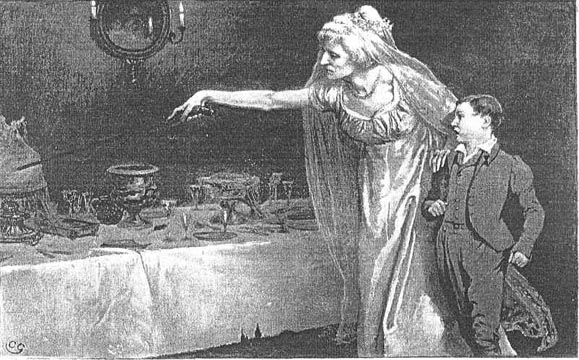
Dickens also gets bonus points for moments of genuine fear and horror. The opening scenes where our hero Pip is threatened by an escaped prisoner are riveting, and Miss Havisham is perfectly creepy while thinking she’s perfectly sensible. Great Expectations is on many lists of gothic classics and Miss Havisham is why. I wouldn’t consider the novel on the whole really gothic or horrific, but she is a great character.
In terms of the plot, Great Expectations feels like a YA novel, actually. Broad and relatable characters, lots of action, a bit of emotional challenge, an attempt to show the reader a part of society not featured much in Dickens’ time, and fairly simple themes that wrap up nicely at the end. The actual word choice and writing style is guaranteed to confuse and bore the average modern kid, but the story fits. Now that I think of it, I feel about Great Expectations the way I do about much of the YA I’ve read. It’s fun and interesting for what it is, but ultimately feels a bit simple for my taste. I suppose, then, I’d recommend this book to people who are pretty much my opposites. If you love flowery phrasing and clever wordplay at every turn, but you like your characters likeable and your endings satisfying, you should totally read Dickens. If you’re my opposite, though, you probably already have.
 Oddly Cultured
Leave a comment