Content note: this novel and its movie adaptation talk about imprisonment and sexual assault.
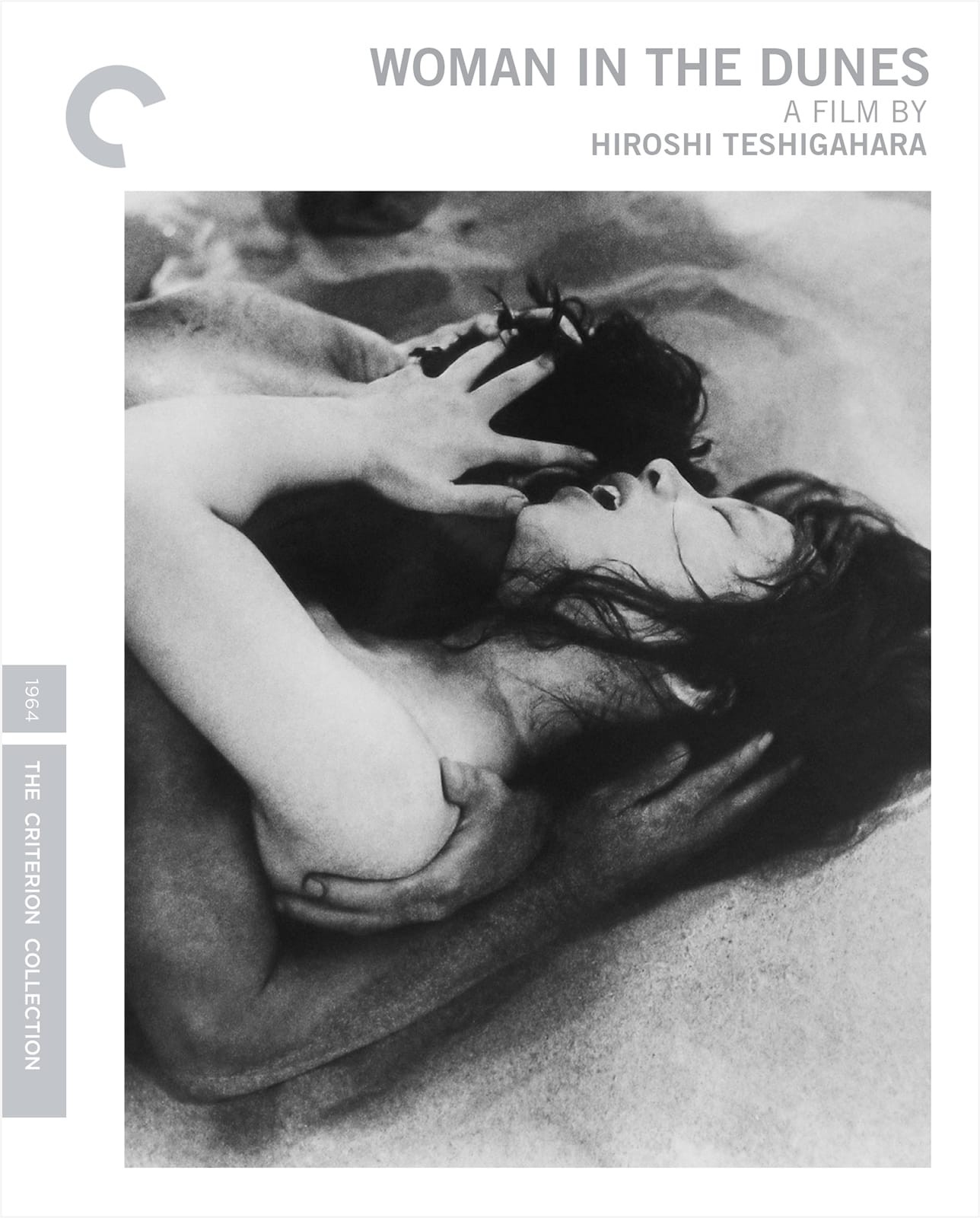
Kobo Abe did a bit of everything–writing, directing, music, photography. He wrote The Woman in the Dunes first as a novel in 1962, then as a screenplay for the 1964 movie adaptation. As I was reading the novel I remember thinking “this would be so hard to film” only to find that the movie version is even more famous than the novel. Shows how much I know.
This story is partly a horror novel and partly an exploration of the meaning (or lack of meaning) of life. The plot is pretty simple. The main character, Jumpei, collects bugs in his spare time and really hopes to discover a new species so he can get his name in a field guide someday. His search takes him to a remote seaside village that’s slowly being buried in sand dunes. He asks the locals where he can find shelter for the night and they show him to a house at the bottom of a hole–the sand dunes have surrounded it but the woman who lives there clears away the sand around her house every night and some locals with a truck haul it out of the pit for her. It’s not exactly an inviting place but Jumpei is tired so he climbs on into the pit and receives food and shelter for the night. In the morning, the ladder is gone. He’s trapped in a hole with this woman, shoveling sand and trying to keep the dunes from swallowing her house. This is his life now.
The rest of the story is us watching Jumpei grapple with his situation, which invites us all to grapple with our own situations in life. I’ve read a lot of this type of novel–I went through an existentialist phase and I still revisit it one in a while–and this one felt pretty average. The endless sand shoveling was an interesting metaphor and done pretty well, but I didn’t really connect with Jumpei and by trying to be both a realistic horror story and a layered exploration of existence it didn’t quite do justice to either one. The movie had the same issue as the book, though it leaned more toward realism than metaphor. As both went on, I found myself less interested in Jumpei and much more intrigued by the woman he was trapped with.
We never learn the woman’s name. She doesn’t talk much and its hard to tell what she thinks of all this. Sometimes she seems like a victim and sometimes she seems like one of the bad guys conspiring to keep Jumpei trapped. We don’t know this woman’s name because Jumpei doesn’t ever ask. He doesn’t care who she is or how she feels about being stuck in a hole, though we do get some hints about her feelings as the story progresses. We find out she was married before and had a daughter, but both were buried beneath the sand during a particularly bad storm. Even hearing this, Jumpei has little sympathy for the woman. Mostly, Jumpei only thinks of himself–he makes escape plans, complains about his fate, eats the food the woman cooks, “lets” her take care of him, has sex with the woman, yells at her and blames her for the mess he’s in. As far as Jumpei’s concerned, the sand around him is more interesting and important than this woman. All this is true both in the novel and the movie–the novel reads much like a play so the movie adaptation is pretty close to the original.
The one major difference between novel and movie is the portrayal of this woman. In the movie, the woman is in there all the time, but she’s mostly a background character. She’s clearly sexually hungry and using Jumpei for sex more than anything, and that gave the sense that she had her own feelings and desires, but that’s about the only thing unique or personal about her. In the novel the woman’s personality shines through a bit more. There are a couple of moments where Jumpei goes too far–once he tries to break boards off the woman’s house trying to make a ladder and once a village elder offers to throw down a rope ladder if Jumpei rapes this woman (while other villagers watch) and he actually tries to do it. In the movie, the woman fights him both times and seeing how upset she is kind of brings Jumpei to his senses. This makes movie Jumpei seem like a nice guy who just got stressed and made some bad decisions. In the book, the woman fights him both times and wins both times. Who knows what novel Jumpei would have done if this woman hadn’t stopped him. The second scene is quite dramatic. Here’s a quote from the novel:
“He heard a noise of cloth tearing, and at the same instant he was struck a terrible blow in the belly by the point of her shoulder, which bore the weight and anger of her whole body. She simply grasped his knees and bent in two. The woman, leaning over him, struck his face again and again with her fists. At first her movements seemed slow, but each blow, delivered as though she were pounding salt, carried weight. Blood gushed from his nose . . . the excitement at the top of the cliff rapidly folded like an umbrella with broken ribs.“
In the novel, knowing she has this strength makes her a really interesting character–she seems broken and maybe a victim, but also capable of fighting back or walking away if she really wanted to. That makes you really want to understand what she’s doing all this for and it makes her a more interesting character than Jumpei with all his self-absorbed existential musings. She’s not staying in this house and putting up with Jumpei purely because she has to but also because it serves some purpose of her own or fulfills her in some way. She’s clearly grappling with her own situation, perhaps with even more thought and depth than Jumpei.
The movie has great visuals and is considered a classic. I don’t know much about cinema so I can’t really judge whether it’s brilliant or not but I liked it fine and it added to my understanding of the book. I found out that filming cliffs made of sand was really difficult because sand doesn’t work that way in real life, so now I’m pretty impressed that the film looked so good.
I would rate this book a pretty average 3 stars. I would recommend it to people with a deep interest in contemporary Japanese fiction and people who are really into existentialist novels. I would recommend the movie to people who like classic cinema and are even mildly interested in existentialism. It’s a pretty quick read so I might also recommend the book to people just looking for something new, but I wouldn’t hold it up as a the best of either Japanese literature or existentialist works.


 Oddly Cultured
Leave a comment