
Content Note: the book I’m about to write about features self-harm. Just skip this post (and Wise Blood) if that causes you problems.
Summer always puts me in a Southern Gothic mood. Maybe it’s because my dad grew up in rural Mississippi but hardly ever talked about his childhood, but the South has always held a sense of mystery for me. Some part of me thinks that by understanding the South I can indirectly understand him, especially now that he’s gone. Anyway, when the weather heats up my mind automatically starts drifting to Southern authors and this year something got me thinking about Flannery O’Conner. On a trip to the bookstore back in May, I picked her novel Wise Blood off the shelf. I really enjoyed it, then read a bit more about what O’Conner was trying to convey and realized I had totally misunderstood the book’s ending. Or at least, I saw something different from what O’Conner was trying to show me. What she was trying to say was a lot more difficult for me to swallow than what I originally got form the book.
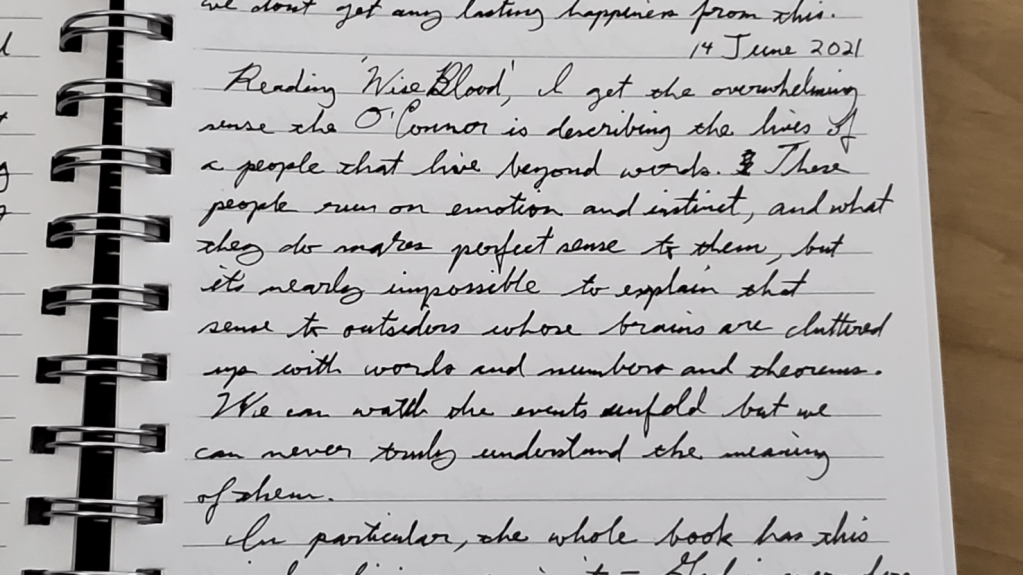
Since I bought a journal on that same trip to the bookstore and started keeping notes about my reading, I can actually look back and see my impressions developing as I got deeper into the book. It’s cool being able to look back, and it makes me wish I’d thought to start a reading journal years ago. I would love to look back on how I understood things back in my thirties or twenties or teens, what caught my interest and what I entirely missed.
But that’s a post for another day. Back to Wise Blood. It was a short book, but not easy to summarize. A lot of things happen but the story is much more than the events it shows us. The story is about a world where God is everywhere but nobody can find him. The main character, Hazel Motes, is running away from God and shouting his disbelief to anyone who will listen. Many of the other characters claim to know God but clearly don’t, or think they’ve found God only to be horribly mistaken, or are so lost they aren’t even looking and wouldn’t know where to begin. Most of the characters are very lost and a little bit horrible and occasionally hilarious, the way characters in Southern Gothic novels usually are, and it can be hard for an outsider (which is most of us) to make sense of their thoughts and reactions to things.
I found the writing style captivating. In my journal I wrote “I get the overwhelming sense that O’Conner is describing the lives of people that live beyond words. These people run on emotion and instinct. What they do makes perfect sense to them but it’s nearly impossible to explain that sense to outsiders whose brains are cluttered up with words and numbers and theorems. We can watch the events unfold but we can never truly understand the meaning of them.” It was a challenge, but a good one, to put myself in these characters’ shoes and understand the world through their eyes.
I said before that the plot was hard to summarize, but to explain what I got from this book (and what O’Conner wanted me to get) there’s a main thread I have to pick out. If you don’t want huge spoilers for a 1952 book, just stop reading here because below there are spoilers galore.
Hazel Motes, as he’s shouting about his disbelief, becomes enthralled by rival street preacher Asa Hawks. Hawks has supposedly blinded himself for Jesus but it turns out he’s a fake. He was going to, got a whole congregation to come watch, but he couldn’t bring himself to really do it and ended up disgraced and scarred but with his eyes intact. Near the end of the book, after all his defiance and many events I won’t describe, Hazel Motes decides he needs to succeed where Hawks failed and blind himself for Jesus. Motes is indeed successful, and from that point on is completely devoted to some pretty serious self-mortification. He hardly eats, forces himself to take long walks with rocks in his shoes, wears barbed wire wrapped around his torso, and eventually dies in the course of these extreme devotions to God.
Now, as Motes is pursuing his extreme devotions, his landlady goes from callously stealing money from her blind tenant and plotting to marry him for his military pension to actually growing quite fond of Motes. She might even be in love with him. At the very end of the story, Motes collapses in a ditch and is brought to the landlady to care for him. The landlady lays his unconscious (actually lifeless) body on a bed and promises to care for him for the rest of his life at no charge. She feels a real moment of connection in that moment and thinks she sees a spark of life in his eye.
What I took from this book was that moment of connection. Throughout the book, so many people were trying to connect with the divine while doing all these mean and self-absorbed and deceitful things, and Motes’s self-mortification seemed like more of the same. His tortures were just another way of looking for God while focusing only on himself. For me, the landlady was the one who wasn’t even looking for God but became more compassionate and had a moment of real selflessness. Maybe we only really find the divine by selflessly loving our fellow creatures. I thought this was kind of beautiful.
Then, as I often do, once I finished the book I looked up more about it. I read more about O’Conner’s life and struggle with lupus, her Catholic world view and some of her comments on Wise Blood, and a little of what critics and scholars have said about it over the years. As I did this, I found out O’Conner meant Motes’s self-torture to be read as a sign of his sincere acceptance of Jesus’s sacrifice. Forget connecting with other people–the way to Jesus is through single-minded concentration and lots of pain. The landlady’s newfound compassion was, I guess, just a response to Motes’s holy communion with God. She wasn’t connecting with him but the light of Jesus inside his mutilated body.
Wow. That put a whole new spin on things. I mean, I grew up in a conservative religious household so the search for God and the Biblical references weren’t lost on me. I even got that O’Conner was criticizing the sort of evangelical tent revival religion popular in the South and favoring a more Catholic conception of the world. I grew up immersed in something closer to Evangelical religion and left (though not for Catholicism) so I really undrestood that angle in the book. I just missed–or wouldn’t let myself believe–that O’Conner was seriously advocating that kind of hardcore ascetic Catholicism. With her lupus she was probably in pain quite often, so maybe she started to see her own pain as bringing her closer to God? Even so, finding meaning in your illness and purposely causing yourself pain seem worlds apart to me. It almost feels like a very Southern take on Catholicism, with the same charismatic vibe and grand gestures she’s criticising about Southern tent revival culture. Huh. Seems if I want to really understand the world my dad grew up in, I have a long way to go.
 Oddly Cultured
Leave a comment