Clara Vaughan and The Old English Baron are two different books. They were written maybe 75 years apart by two entirely different people but surprisingly, they have a lot in common. They’re both about young aristocrats with murdered fathers, they both involve ghost sightings and amazing coincidences, and they’re both way too long. Honestly, a lot of gothic novels are way too long but I love them anyway.
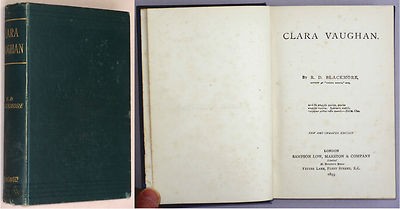
Let’s start with Clara Vaughan because I read that one first. It’s written by R.D. Blackmore and published in 1864. The story is this. Clara’s father was mysteriously murdered during her childhood, and the story follows her as she grows up obsessed with solving the murder and taking revenge on the killer. There are many obstacles and detours on her path to vengeance.
As a mystery, this story is not great. Clara spends the first two thirds of the novel kind of spinning her wheels, finding a few clues that lead nowhere, working with a London detective who isn’t very helpful, nearly being blinded by dangerous chemicals, and being poor because her inheritance has been denied her. We get to know the lovely farm family Clara and her mother live with, who speak a faithfully rendered dialect that I had some trouble deciphering. We get to know Clara’s landlady in London, her unsavory husband, and the debt collectors who constantly bother them. We get to know Clara’s beautiful friend Isole and her artist brother. We get to know all these people really, really well. For chapter after chapter, while the murder investigation goes nowhere. I got really bored at times and wandered off to read quicker, more exciting novels.
The story picks up in the last few chapters, though, and actually gets quite exciting. Clara rescues her uncle from a relative scheming to kill him off and steal the family fortune, and out of gratitude her uncle tells her the whole story behind her father’s murder. That’s right, her uncle has known all along. No one really solves the mystery, he just confesses what he knows, which is everything. Still, it’s a pretty epic story. These last several chapters have a lot of excitement and danger and drama, and Clara has to do some really brave and clever things to save herself and bring the killer to justice. She also does a couple of really dumb things that almost get her killed, and that’s exciting too. I loved these last chapters, and I have to admit most of the characters we got to know waaaay too well all come together in a kind of grand finale that was fun. In spite of the slow start, I ended up really liking this book.
The Old English Baron was too long in a much different way than Clara Vaughan. This one was written by Clara Reeve in 1777 as a kind of response to the famous Castle of Otranto, written several years before. Otranto was a big dramatic story with big dramatic ghosts in it. I liked it a lot, and wrote about it here. Clara Reeve, apparently, thought Otranto’s ghosts were too over the top and wanted to write a more toned down and realistic ghost story. So she did. It’s not bad, really. This one starts with Sir Phillip Harclay, a noble knight come home from the crusades, looking up an old friend only to find his friend’s castle under new ownership. Harclay’s friend, Lord Lovel, has died, and Lovel’s brother sold the castle to Lord Fitz-Owen and his family. Fitz-Owen has several children and a local peasant boy, Edmund, he’s offered to educate and train, hoping to make him squire to one of his sons.
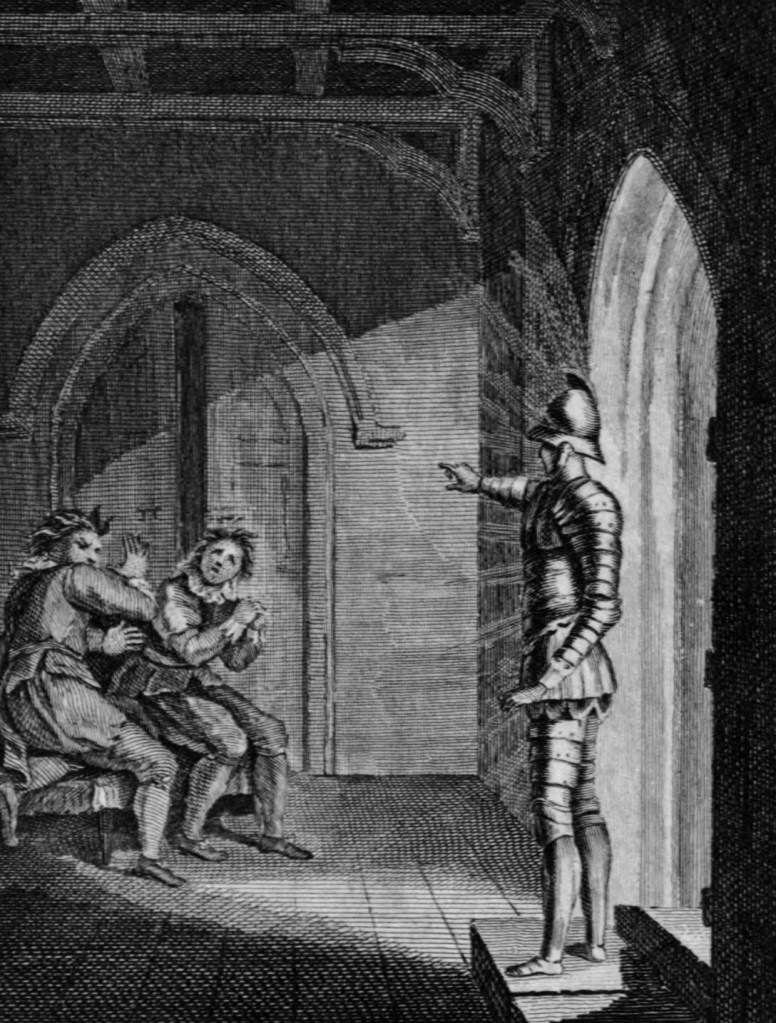
Well, turns out that Lord Lovel may be dead but his spirit still haunts his old castle. The ghost appears to Edmund and reveals that he himself is Edmund’s father. Upon learning this, Edmund sets off to prove his parentage and bring his father’s killer to justice. It’s a noble story, where the good guys are all generous and wise and all the bad guys are brought low in the end. There aren’t a lot of twists and turns here, but it’s satisfying the way tales of chivalry usually are. It’s also more realistic and grounded than most gothic novels, which is what Reeve was going for. She was writing way before psychology was invented, so none of the characters really have the deep motives or inner monologues a more modern writer might include, but Reeve’s characters do have a touch of emotional reality to them that’s nice to read.
Clara Reeve tends to overexplain things, though. She’ll spend a lot of time naming every single person attending the trial by combat, or discussing exactly who will live in which castle once Edmund receives his inheritance. The story would be more gripping if she spent more time on the actual combat and less on the judges and spectators. I often found myself impatient, thinking ‘yes, yes, you’ve already told us this, but what happens next?’ I don’t suppose writers in the 1700s had a team of editors to help them tighten up their novels and punch up the drama. Some rambling is to be expected from older books, but this one is especially repetitive in parts. Since Reeve invites comparison directly with the Castle of Otranto, I’ll say Otranto moves more quickly and is a more exciting read even if it is a bit over the top.
If I had to rate these books, I’d give Clara Vaughan 3 out of 5 stars. Two stars for the ending, one star for the rest of the book.
I’d give The Old English Baron 1 1/2 stars. It was fine but forgettable. Sorry Clara Reeve, but Otranto did it better.
 Oddly Cultured
Leave a comment