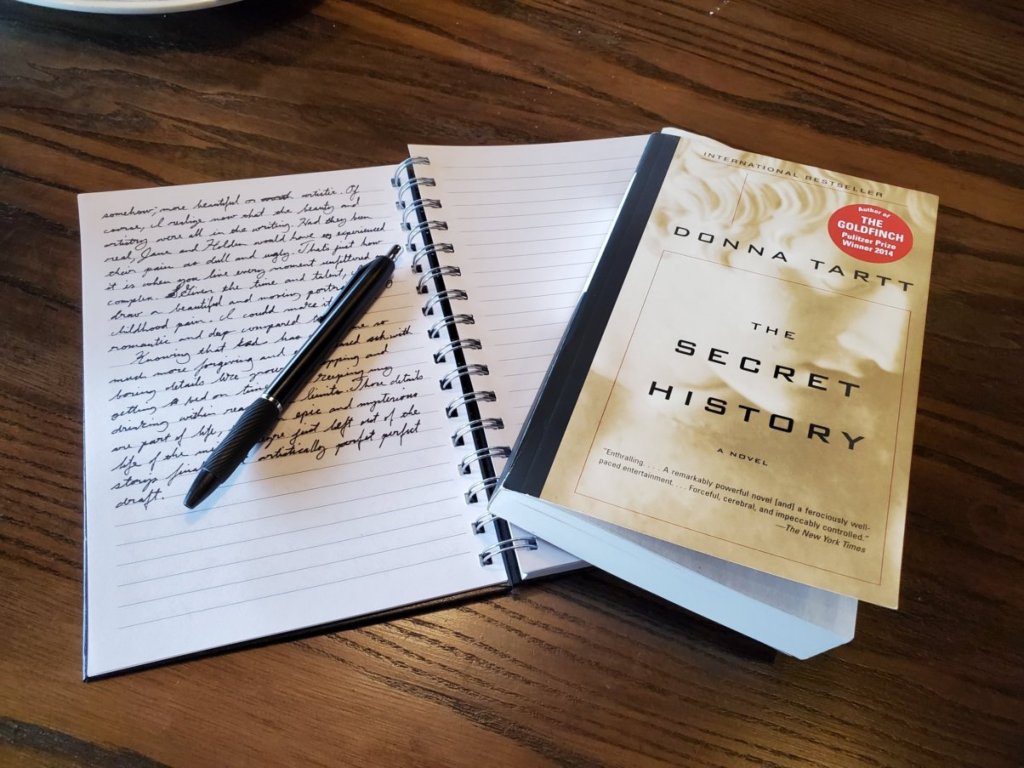
As part of my new obsession with Dark Academia, I picked up Donna Tartt’s The Secret History. This, the internet tells me, is the foundational text of Dark Academia. Now that I’m finished, I can see why. It’s a unique mix of artistic idealism, the search for meaning in the modern world, punk rock class consciousness, and debauched self-absorption. This is the kind of book that you find your thoughts drifting back to in the oddest moments. I didn’t exactly love The Secret History; I didn’t feel anything as simple as love or hate for it. It will stick with me for a long time, maybe because it will take a long time to sort through my thoughts and feelings about it.
The story revolves around a murder. This isn’t a spoiler. The Secret History isn’t a mystery novel. It’s more a set of character sketches and vignettes woven together around this moment of murder. There’s not much traditional plot here–most of the intrigue is in getting to know a set of eccentric Classics students and what their life is like at Hampden college. Tartt is originally from Mississippi, and there’s a Southern gothic flair to her descriptions of these quirky students from rich families, who dress in thrift store clothing yet spend their weekends in an aunt’s big empty mansion out in the countryside.
The story’s narrator, Richard Papen, grew up bored and frustrated by his ordinary suburban life and found more of the same boredom in college. It was all just so numbing and utilitarian. When he transfers to Hampden, a tiny and very expensive liberal arts college up in Vermont, he finally has a chance to live a more artistic and intellectual life. I’m not sure he finds any actual meaning in it, though, and it certainly doesn’t stir any deep warmth or humanity in Richard.
Hampden and its students are based on the real life Bennington College, which Donna Tartt attended and enjoyed with several other now-famous authors. She attended at the same time as Brett Easton Ellis and they knew each other and read at least some of each others’ work. This makes so much sense–these characters have the same cold and unreal feeling Ellis’s characters in Less Than Zero have. The authors shared experiences, had some of the same mentors, were handling some of the same themes. It’s been a long time since I’ve read Less Than Zero or American Psycho, but I can still feel the similarities. Not in writing style, but in the detached style and the way the characters are captured. Also, oddly, in the ’80s style listing of brand names and focus on consumer goods.
A lot of people seem to think The Secret History (and Less Than Zero, for that matter) are satire, or stylized, or wildly exaggerated for effect. I can see why they think this–the characters use truly ungodly amounts of drugs and alcohol, dearly love the ancient Greek classics yet rarely seem to be in class, and are sometimes just so artsy it hurts. When I read what Tartt and others say about Bennington in the ’80s, though, their memories seem pretty close to what the book depicts. It was a unique time and place. They may be poking fun or focusing on the more salacious parts, but I’m not sure they’re exaggerating much.
I mean, no one murdered anyone in real life. Not that I’ve read of, anyway. It’s fascinating to me that Tartt speaks of her Bennington years as the happiest time in her life, but she very purposely centers her novel around this murder and the way it tears apart the lives of the people involved. There are some other dark parts I won’t spoil for you as well that do seem to be specifically added to give the novel a darker edge. In the novel, this college seems like a fascinating place to really explore your artistic side and be truly yourself, but it also seems like a deeply scary place where everyone is so busy pretending to be interesting that they’re barely human anymore. This tension is what I really find compelling about The Secret History, but knowing it’s based largely on real people Tartt was friends with gives this story another layer I don’t quite know what to do with.
This is the type of college I secretly dreamed of going to when I was in high school. I’ve mentioned before that I didn’t go to a college even remotely like this. It was conservative and religious and that sucked, but it was really cheap (I graduated with no debt at all) and actually pretty solid academically. Zero debauchery, but I did spend four years learning literature and philosophy and I loved that part. Still, sometimes I fantasize about the more artsy places where rich kids go to “find themselves.” The Secret History definitely has moments that stoke those fantasies. There’s also a lot here that turns me off and feels kind of tragic and morally bankrupt.
Somewhere recently, on Reddit maybe, someone described Dark Academia as not embracing elitist notions but punkishly borrowing from them. I might add that Dark Academia combines elite interests and aesthetics with pop culture in a way that makes them more accessible and somewhat subverts elitism. That seems an apt summary, both of the aesthetic and The Secret History. Perhaps that’s why there’s such a dark side running through it–these characters are genuinely searching for meaning in art, in study, in ancient lives and writings, but along with meaning they also carry darkness back into their modern lives. Does it actually come from the past? Was the past a dark place? Or is modern life so dark and self-absorbed that it just twists and taints whatever meaning you find? Did these experiences actually ruin these characters’ lives, or were their lives already destined to be sad and meaningless, except for those brief Hampden years when they reached for something deeper? Perhaps the tragedy isn’t that they killed someone, or that they failed, but that they stopped reaching? If I could take an actual lesson from this book, as I sort through the various themes and connections it’s shown me, it might be that. Never stop reaching for meaning, even if you do brink darkness back with you.
 Oddly Cultured
Leave a comment