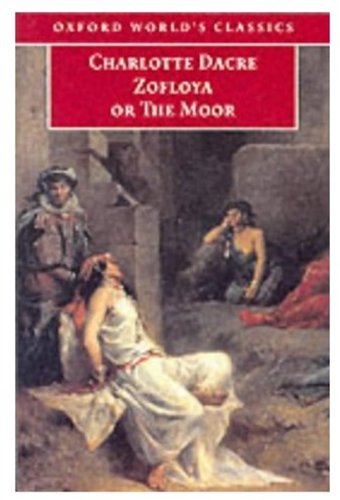
 I finally finished Zofloya: or The Moor by Charlotte Dacre. I couldn’t find it on Project Gutenberg and I couldn’t look for a library copy because of the COVID lockdowns, but Kindle had a version for only a dollar. This version had more weird typos than I like but it was fine for the price. It’s not a long book, but for various reasons it took me over two months to reach the end. As one of the very few gothic classics featuring a non-white character, this book accidentally touches on current events. I will be talking about the racial dynamics in Zofloya, but that’s not where I want to start. I want to start with the novel as a whole and its original Victorian audience.
It seems that Dacre’s novel, when first published, was condemned by critics but very popular among regular readers. The main complaints from the critics seemed to be a)it’s so shameful for a woman to write such graphic sex and violence and b)this is just a rip-off of The Monk anyway.
As a modern reader I think the graphic sex and violence are what make this book so great and I think Dacre was brave to put this out there. Forty years later the Bronte sisters would publish under male-sounding pen names, but Dacre used the feminine name of Rose Matilda, never hiding the fact that a woman was bringing you this scandalous story. As for being a rip-off of The Monk, I don’t buy it. The pen name Rose Matilda is clearly a reference to the temptress Matilda in that book, and Dacre clearly used some elements from that story (and threw in some references to Ann Radcliffe’s Mysteries of Udolpho as well) but it reads like a conscious reworking or play on The Monk, not a cheap rip-off. In fact, while it borrows its basic format from Lewis’s novel, Zofloya is much more elegantly structured and well-paced than The Monk and feels much more purposeful in its themes and characters.
The prose reads as amazingly modern. Compared to the average gothic novel, or really any Victorian novel, Dacre’s writing is lean and simple. For the most part, she avoids the long descriptions of sublime nature (looking at you Ann Radcliffe) and the wandering subplots (really looking at you Matthew Lewis) so common for her time. Her story has the absurd plot twists and supernatural elements you expect from gothic novels, but Dacre takes care to fit them all into an elegant whole. This makes the novel fairly easy to read and quite satisfying.
Zofloya is an amazing romantic tragedy folded inside a heavy-handed morality tale. The story begins with Laurina di Loredani being seduced by the wicked count Ardolph. Laurina runs off with Ardolph, leaving her family in social ruin. The story then follows Laurina’s daughter, Victoria, as she follows and exceeds her mother’s bad example. Victoria is left with a cold and vindictive relative, and when she makes her clever escape she runs to the one person she knows can protect her–the Conte Berenza. She doesn’t exactly love Berenza, but she knows he loves her. After five years of marriage, Victoria is bored and tired and irritated by Berenza’s condescending manners. When Berenza’s younger brother Henriquez comes to stay, Victoria becomes obsessed with him. This is where Zofloya enters the picture–Zofloya was once a Moorish prince, but is now the personal slave of Henriquez. Zofloya becomes devoted to Victoria, who at first uses him as a willing helper in her plans to murder her husband and seduce Henriquez, but eventually develops a love relationship with Zofloya himself. There are more twists and turns to the story, because good gothic novels always have more twists and turns, but I don’t want to give everything away yet.
One one hand we have the morality tale. Dacre comments throughout on how fallen and sinful almost every character is, but especially condemns Victoria. Victoria is a selfish impulsive girl who becomes more and more lost in sin, and her friendship with the slave Zofloya only drags her faster toward the pits of hell. The morality tale plays on Victorian fears of sexual women, fears of slave revolt and of “savage” colonial subjects killing white men and ravishing white women. At the story’s end, it is revealed that Zofloya is actually Satan and Victoria has literally lost her soul to sin. Like I said, heavy-handed. Also totally playing to Victorian racism and colonialism.
Since Victorian readers already knew to condemn those things, Dacre’s commentary kind of reads as if she’s just guessing what the reader already thinks: “Oh, I know, how awful she is to poison her husband. She’s so shamefully lusty to dream of that Moor, isn’t she? You and I reader, we’d never do that no matter how tempting it looks.” Maybe Dacre meant every word and this whole story is meant to warn readers about the dangers of lust. Maybe she just put it all in to head off controversy. The book (and Dacre herself) drew a huge amount of criticism as is–I can’t imagine the condemnation she’d get without all the sermonizing. Either way, the morality tale aspect feels like a thin coat of whitewash painted onto a rich, exciting romantic tragedy.
The romantic tragedy is quite subversive, and not just about race. Victoria may be selfish and sinful, but she’s a survivor. She’s a strong and independent woman who, by her own wit and willpower, escapes a remote country estate and hikes back to Venice, and convinces the rich and handsome Conti Berenza to marry her in spite of her poverty and bad reputation. Victoria is definitely a villain, but she’s also awesome. Zofloya is also awesome. He’s handsome and always well-dressed, he’s intelligent and decisive, he sings like an angel, and his devotion to Victoria is quite tender. Compared to Victoria and Zofloya, everyone else in this book is fairly bland and weak. These two are evil, but also totally understandable and clearly the heroes of the story.
While the moralizing parts paint Victoria as a relentless sociopath, the romantic tragedy clearly shows that the world is trying to break her and she won’t let it. When the world tries to stomp on Victoria, she stomps back. Even Zofloya sometimes tries to keep her down and she won’t let him.
The moralizing would also have us judge Zofloya and condemn his underhanded plots, while the romantic tragedy has us rooting for this man to avenge himself on his oppressors and win the love of the proud, fierce Victoria. This romantic arc has its end in a bandit cave–as they hide out there from the law, romance blooms between Victoria and Zofloya. The tragedy is that even here their love is not accepted and whenever the bandit leader is watching, Zofloya must pretend to be only a servant instead of Victoria’s lover. On this level, the novel is exciting and poignant even for modern readers. In fact, it might be sadder as we realize how controversial interracial relationship still are in many places.
This book can either feel uncomfortably racist and colonialist for making Zofloya the devil or refreshingly progressive for featuring nuanced and well-crafted characters who defied the conventions of their time, depending on which story you find most compelling. Since I tend to ignore the sermonizing in gothic novels and focus so much on the characters and plotting, I ended up really excited by Zofloya and Victoria. If I read this book again I would stop right as the couple were fleeing the bandit’s cave a few pages from the end. Instead of finishing the morality tale, I would imagine them finally reaching safety and living in peace with each other. But that Satanic ending does exist, and it’s very much a racist Victorian ending. All reading experiences are valid, and yours will heavily depend on your own history and personality.
After its initial success, people kind of forgot about Zofloya for a few decades, but it’s making a comeback as academics analyze the race and class dynamics and the bold female sexuality in Dacre’s novel. This book is unique among the gothic classics I’ve read so far and I’m glad it’s becoming more known again. I give it four haunted stars.


 Oddly Cultured
Leave a comment