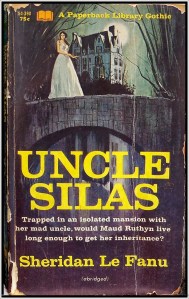
 Because I love Carmilla, I decided to read Sheridan Le Fanu’s most popular novel. I was disappointed in Uncle Silas: A Tale of Bartram-Haugh. Usually I enjoy writing book reviews because they help me analyze how the story works (and doesn’t work) and understand my feelings about a story. I don’t have any strong feelings about Uncle Silas, though, and I know exactly why so I’ve been putting off this review. Much like Bartram-Haugh itself, there’s not much mystery here.
This story is told in the first person by Maud, the main character, in the past tense. From the beginning, it’s clear that Maud is now an older and wiser woman looking back on the events of her teenage years. Maud tells us how she spent much of her early life on a large country estate with only her father, a handful of servants, and a string of governesses for company. One of the governesses, a French woman, is weird and mean and is eventually fired for searching through Maud’s father’s private papers. Not long after that, Maud’s father dies and Maud is sent to live with her uncle, Silas. Long ago, Silas was suspected of murdering a friend and fellow gambler who died at Silas’s estate of Bartram-Haugh. Maud’s father, who always believed Silas’s innocence, is hoping Silas can dispel these horrible rumors once and for all by successfully caring for Maud until she reaches adulthood. You see, if Maud dies under Silas’s care then Silas will inherit everything. If Silas is truly the evil murderer people believe him to be, he will try to kill Maud and/or steal her fortune. If he is a good man, Maud will be fine.
Turns out Silas is not a good man.
Of course, since Maud is telling this story about her own past self, we know from the start that whatever happens, Maud survives. We can also tell from the way Maud talks that adult Maud is not just alive but rich. At one point she talks about meeting the Queen of England, so adult Maud might even be famous or important. Knowing this sucks all the suspense out of the story–no matter how creepy her uncle acts, no matter how many unpleasant events happen at Bartram-Haugh, we already know Maud is going to be fine. Adult Maud, as she tells the story, doesn’t seem really traumatized at these events; she seems more frustrated at how passive and gullible she was as a teenager.
There’s also precious little mystery to this story. It’s pretty clear from the start that Uncle Silas is a creepy, unpleasant man bent on getting Maud’s money by isolating her from friends and family and either forcing her to sign it over or arranging for her death. We know the weird French governess is involved somehow, and so is Silas’s rapey son. There are some questions about what exactly they’re planning to do and how they’re going to accomplish it, but the main plot points are pretty obvious. There’s a long, long build up with much talk of how scared Maud is and how strangely everyone acts, but the plot has very few twists or surprises and for most of the novel nothing actually bad happens to Maud. The final act of the story creates some sense of danger and mystery, and there is some violence, but it’s too little too late.
Le Fanu was clearly trying to create memorable characters but they never quite came alive for me. Having Maud narrate her own story might have been an attempt to give her some psychological depth and make her more strong and interesting than the average gothic heroine, but I don’t think he was successful in this. Even with her own descriptions of her thoughts and feelings, Maud isn’t a compelling character. Those problems and the over-long buildup and lack of suspense all made for a fine but forgettable novel. I give it two haunted stars.


 Oddly Cultured
Leave a comment