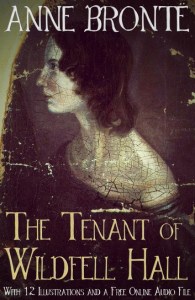
 I decided to check out the other Brontë sister. You might have read Charlotte’s Jane Eyre or Emily’s Wuthering Heights, and if you studied them in school you might have heard there was another, less famous, less brilliant sister. That would be Anne. The Tenant of Wildfell Hall was her second novel.
Having also read Wuthering Heights and Jane Eyre, I was expecting something different from what I got. I went in expecting sweeping romance and creeping evil, but instead I found a disturbingly realistic picture of an abusive marriage and a woman with very few options.
The story begins with a young widow, Helen, and her son moving into an old broken down mansion on the edge of town. If this were a proper gothic novel, ghosts and villains would haunt this mansion, but instead Helen is befriended by local gentry and then shunned when rumors spread that she’s secretly the mistress of a local lord, Mr. Lawrence. Helen couldn’t care less about her reputation, but she can’t bear the thought of Gilbert, her good friend and sort of love interest, might think she’s capable of such sin. To clear her name with him, she lends him a large chunk of her diary. Most of the book is a copy of these pages which tell the story of a naïve young Helen falling for the dashing but wild Arthur Huntingdon. Instead of settling into married life, Arthur sinks deeper into gambling and drinking, bringing his equally drunk friends around, and eventually openly having affairs that Helen can’t do anything to stop. Arthur and his friends think it’s funny to give their toddler wine and teach him to swear, and when Helen protests he calls her names and tries to turn their son against her. After a few years of this and a failed attempt to flee to America, Helen’s brother helps her escape with her son and sets her up in Wildfell Hall under a false name. At the risk of century-old spoilers, Mr. Lawrence turns out to be her brother, not her lover.
The novel has its flaws, to be sure. This is a morality tale, and Anne spends a lot of time making sure we know how awful all these sins are. Too much time, I’d say, as there are several long passages that read as lectures on the evils of drinking and gambling. The main character, Helen, is sometimes real and human and sometimes as cold as a saintly marble statue who holds people to an impossible standard of goodness. Anne wavers between heartbreaking realism and flat sermonizing, as if she’s trying to write two very different books at the same time.
There are also some organizational flaws. They weren’t bad enough to ruin the story, but they interrupted the flow a bit. Anne introduces a lot of minor characters and does an admirable job of keeping track of their stories and telling us what happened to each person, but she picks seemingly random times to give us these updates. The story’s framing is also a bit awkward, as technically this whole novels is supposed to be a series of letters from Gilbert to his brother-in-law. First, it’s a bit weird to copy 500 pages worth of Helen’s diary for a man you see every year and second, this brother-in-law is almost the only character we learn nothing about. He and Gilbert are good friends, but we never learn who this guy really is or even how he met Gilbert’s sister. Why, Anne, why?
When this book shines, though, it really shines. Even though we’re meant to thoroughly hate what Arthur and his friends are doing, Anne takes great care to show many of them as complex people with realistic regrets and motivations. It feels as if Anne gave Jane Austen’s books a gritty reboot where all the happy weddings give way to disappointment and loveless marriages. Much of it felt real and raw even for a modern reader. I loved that Anne, even as a clearly traditional and religious woman, shows Helen as completely right for fleeing from her husband. In an era where divorce was often impossible even for women who were clearly physically abused, it seems pretty bold to have the main character leave over “only” cheating and alcoholism. Spoiler alert: Anne does have her heroine return to nurse her husband through his last illness and death, but even then Helen has Arthur sign a legal contract that lets her and her son leave at any time if she feels threatened.
Morality tale though it is, Anne shows real compassion for many of her vice-ridden villains. While Arthur himself becomes worse over time, his friend Hattersly eventually grows out of his youthful wildness and decides to settle down and be nicer to his wife. Another friend, Lord Lowborough, struggles with addiction to gambling and alcohol and a cheating wife. In this he and Helen are mirrors for each other, both being swept away by charm and beauty only to find their spouses are rotten on the inside.
Anne may be the least of the Brontë novelists, but I was still completely fascinated by this novel. It doesn’t have the romance of Jane Eyre or the bleak passion of Wuthering Heights, but it’s got a realism and nuance that makes it a moving novel and an interesting window into Anne’s world. If you’re looking for horror this will not scratch your itch, but if you like Victorian and Regency flavor and relationship drama you will not be disappointed with The Tenant of Wildfell Hall.
 Oddly Cultured
Leave a comment