The soundtrack for this is Bauhaus. Only the gothest of goth bands for the bleakest yet most darkly funny of gothic novels. Queue up your favorite tracks and follow the tale of Melmoth The Wanderer by Charles Maturin.
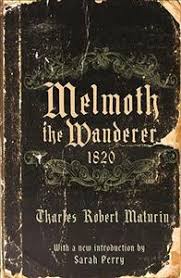 I read Melmoth on and off over several weeks. Project Gutenberg has it for free download in four volumes. It’s less a novel and more a series of nested stories, all centered around encounters with the titular Melmoth the Wanderer. The book begins with John Melmoth, a college student visiting his miserly uncle on his deathbed, who discovers a manuscript detailing an encounter with John’s ancestor, the legendary Melmoth the Wanderer. The Wanderer was a practitioner of the dark and secret arts–the book isn’t much more specific than that–and sold his soul to the devil for 150 more years of life, only to find he was cursed to spend that 150 years trying to tempt other desperate people to sell their souls and fulfill the bargain in his place. The Wanderer’s search takes him to a mental asylum, to the dungeons of the Inquisition, to great families fallen on hard times, to heartbroken women, to shipwrecked sailors and desperate prisoners, and finally to a young girl stranded alone on an island. He falls in love with this stranded girl and she, in spite of his cursed state and evil disposition, falls in love with him. Of course, this forbidden love ends most tragically of all, and in spite of searching and seducing for 150 years the Wanderer finds not one person who will forsake God and take his place, and after all that he returns to his ancestral home (where he meets his descendent John Melmoth briefly) and faces his death and eternal damnation.
The Wanderer’s story, though, is only the thread that holds together the real, meaty stories in the novel. Most of the book is about the adventures and misfortunes that led each character to their desperate states. The book’s general atmosphere is incredibly dark and despairing as one character after another reaches the lowest point in their life only to be tormented by this accursed Wanderer, who offers to save them if only they’ll sell their souls, and when they refuse the Wanderer just leaves them to whatever horrible fate awaits them, whether they deserve it or not. Most of the characters, in fact, are innocent and trapped by circumstances beyond their control, making it even sadder that no one is coming to save them.
A fun bit of trivia that relates–Oscar Wilde, exiled from Ireland after serving jail time for “gross indecency” after being outed as gay, called himself Sebastian Melmoth after gay icon Saint Sebastian and damned wanderer Melmoth. In terms of plot and characters, this is a gothic novel through and through, but in terms of theme it has more in common with modern existentialists and dark realists like Steinbeck or McCarthy or Sartre and De Beauvoir. I found that really fascinating. It’s dark stuff, and it’s difficult to read over a thousand pages of that stuff without getting exhausted or depressed, which is why I ended up reading this in bits over several weeks. The episodic style of storytelling made it easy to break the story into easy chunks. I’d read and have fun, and when the existential despair got too much I’d take a break and read lighter horror. (I read The Girl with all the Gifts at the same time as Melmoth and it was a great palate cleanser.)
Melmoth the Wanderer is often considered the last of the gothic classics in the British tradition and it’s by far the bleakest, but it’s also got a lot of humor and camp and the stories are often darkly funny. Like Matthew Lewis in The Monk, Maturin seems to know how campy and exaggerated his stories are and to enjoy taking the gothic drama to the most ridiculous heights he can think of. He’s also quite good at writing in visual details of places and people that round out the characters and pull you into the story even at its most unbelievable. There are great moments of both drama and comedy and the book as a whole rocks between hope in a a glorious afterlife for these good people and a stark declaration that whatever the afterlife brings, this life is filled with sorrow and evil.
Maturin started his career an Irish Protestant preacher, and this definitely informs his writing both on the surface and on a deeper level. On the surface, his opinions on organized religion are pretty clear–he’s anti-Catholic, antisemitic, deeply opinionated about various Protestant controversies I couldn’t really follow, and believes all the worst exaggerations of Hinduism, while piously praising the pure worship of Jesus as the best and only hope for humanity (he makes clear that atheism is as stupid as all those other stupid religions). At times he was so mean-spirited I worried I should be offended, but he was so over-the-top mean about every religion ( including his own at times) I just started to laugh at him.
On a deep level, he seems much more conflicted about faith, wanting to tell us a hopeful moral sermon while mostly telling us lurid tales of temptation and horror instead. He’s trying to tell us no one, no matter how desperate, would willingly let Satan into her life while showing us villain after villain who profess their faith and goodness while screwing over innocent people. It’s such an interesting mix of faith and bitterness.
I give Melmoth the Wanderer a solid 3 Haunted House rating. I didn’t enjoy every minute of it but I’ve been finished for a couple of weeks now and I’m still thinking about it. While not the most readable, it truly is a great peak among gothic novels.


 Oddly Cultured
Leave a comment