Before we get started, here’s some music to set the mood:
I slowed down but didn’t stop my gothic novel project over the summer. I managed to read John Polidori’s The Vampyre, which I’ll review later, and J. Sheridan Le Fanu’s In a Glass Darkly. This is the book that features the famous Carmilla; you might be tempted to skip straight to that one but the rest of the stories are also worth your time.
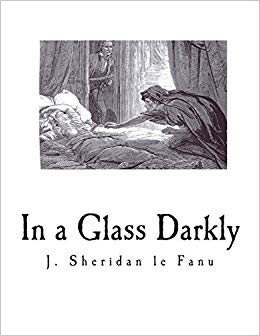 You might already know that “in a glass darkly” is a Biblical reference about how we in this life see only glimpses of the world beyond. It’s a fitting title for Le Fanu’s collection of stories, which pretends to be the case notes of Doctor Martin Hesselius, who studies and helps people who see too much of the world beyond and suffer for it.
There are five stories–Green Tea, The Familiar, Mr. Justice Harbottle, the Room in the Dragon Volant, and Carmilla. The first three are heavily psychological and each is more spooky and interesting than the last. Justice Harbottle was my favorite of these three, with an excellent combination of psychological guilt and supernatural vengeance. The Room in the Dragon Volant lightens things up a bit with a mystery adventure. The narrator of this one is looking back on his foolish youth with a mix of nostalgia and embarrassment at the trouble he got into. I found it quite fun–humor doesn’t always translate across the centuries but this one works.
And then He gives us Carmilla. Le Fanu deserves to be remembered for more than Carmilla–he has an exciting and readable style and his stories are a lot of fun–but Carmilla is a true gem of gothic storytelling. Le Fanu has a real gift for making standard gothic tropes seem fresh and personal–the remote castle, the lonely young maiden, the predator in the night all feel real and moving, and the story builds nicely from lonely longing to spooky tension to a fairly gruesome finish. This is the original charming vampire story–people are more familiar with Bram Stoker’s story but Dracula borrowed heavily from Carmilla.
Much has been made of Carmilla as the original lesbian vampire and perhaps that’s why this story hasn’t kept its fame as well as it deserves. Some people probably can’t see past that fact into the nuance of the story. Most, if not all, modern adaptations of Carmilla are pretty campy and simplistic. It’s a shame, because the romantic tension between the narrator, Laura, and Carmilla is fascinating and full of layers. There’s clearly passion and sensuality between the two but its exact nature is up to the reader to decide.
It’s not at all clear that Laura is gay. Victorian stories are full of female best friends who are passionate without being sexual–I think this comes from the Victorian idea of well bred women being so pure and innocent they don’t think about sex ever (it would never occur to these characters to have sex, even if they sleep in the same bed). and we can’t even be certain that Carmilla is gay–it’s possible she targets young women because that’s what she looks like and it’s easy for her to worm her way into other young women’s lives. But she could be in love with Laura. She could be looking for a companion in death. We just don’t know.
This story is the root of so many modern vampire stories, it’s a shame Carmilla herself hasn’t been explored more. She’s an utterly compelling villain and I would love to see a screen adaptation worthy of her.
I give this book 5 stars and I’ll definitely be exploring Le Fanu’s other writings sometime soon.


 Oddly Cultured
Leave a comment