Christmas makes me worry about stuff. Literally, I worry about the stuff I buy and own, whether it’s the wrong stuff, too much stuff, whether I appreciate my stuff enough . . . . Every Christmas a bunch of my mainstream middle class friends start bitching about consumerism and how Christmas is so commercial (usually while buying a ton of Christmas stuff) and my anxiety kicks up a notch or two and I start researching minimalism once again.
Minimalism gets in my head. It’s not just a design trend anymore. It’s a life stance, an ethic, maybe even a spirituality, and that’s what gets in my head. I have trouble with scrupulosity*–unreasonable guilt over moral issues–so the second a trend takes on a moral tone I start to worry about it. I did this about religious rituals, I did this with vegetarianism, I continually do this about my parenting, and every Christmas I do this with minimalism. I don’t even like minimalism, really, I just obsess over it. Aesthetically, it isn’t for me at all. It looks antisocial and impersonal to me. Ethically, it seems like just a different way of obsessing over stuff–instead of obsessing over the most and biggest things they obsess over the most perfect things in the most perfect setting. But the simplifying and anti-consumer stuff really triggers my anxiety. A decade or two ago, when I was severely depressed and my guilt seemed totally reasonable, if minimalism had been this big I might have fallen straight down the rabbit hole. I would have gone crazy trying to live with one spoon and one chair and feeling guilty for wanting art on my walls.
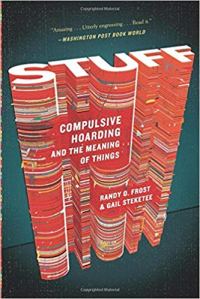
I’m especially prone to guilt about buying and owning because my mom’s a hoarder. She’s not quite reality TV level, but she’s got several unusable rooms, mice she can’t get rid of, and all the classic psychological signs. Hoarding is an anxiety disorder, but it’s often treated as a morality play about the evils of consumerism, so of course my scrupulosity and my fear of becoming my mother work together trying to push me off that minimalist cliff.
To be clear, I’m definitely not a hoarder. When I’m in a healthy place I’m quite sure of this. Hoarders aren’t just collectors (me) or bad housekeepers (also me); they get great anxiety at giving away or even organizing their hoarded goods (this is my mom), and I don’t have that at all. They also often go into debt or let their homes become unsafe for the sake of their hoards, and I’ve never had trouble with either of those things (my mom has done both). My guilt and anxiety are not rational. But they’re constant, and sometimes they’re really powerful.
So what does this have to do with goth? For most people, not a thing. Most people can redecorate their homes or window shop for the perfect vampire cape without any anxiety or guilt at all. Me, not so much. I worry about feeding consumerism, about spending money on things I don’t strictly need, about how much decoration is too much (I grew up in a house full to the rafters with art and tchotchkes, so this looks normal and cozy to me). If I want anything, goth or not, I struggle with guilt and anxiety about it. It doesn’t plague my every waking moment (not anymore, at least) but it’s always there. Many goths don’t like the rise of goth status brands or the pressure to have the perfect goth look and lifestyle, but most of them don’t feel actual guilt or anxiety about it. I’m special that way, I guess.
Goth has always had a material side. Even in the old DIY days there was music to buy a look to maintain, and that requires shopping and owning stuff. And nowadays, goth often has a more consumerist bent, with product placement and status brands and even more emphasis on the perfect makeup and wardrobe. Sure, goth is about what’s inside, but it’s also about translating that inner worldview into a real world aesthetic, and that will always require buying and owning a certain amount of stuff. That stuff almost always fills an emotional or creative need, but the scrupulous voice in my head doesn’t see those as real needs, so in the past I’ve talked myself out of a lot of lovely things that way. I’ve talked myself out of following my passions and expressing myself that way.
Looking back, all this moral anxiety was a huge factor in my “normal phase.” My extreme moral guilt made pretty much all my hobbies and interests and all my personal aesthetic taste seem morally wrong in some way. All my moral anxieties–consumerism, eco-consciousness, social anxiety, my strict religious upbringing–combined against me. The very act of putting my own pleasure above something “more moral”, like giving to charity or saving the environment, felt wrong. Of course, no one can be perfectly moral and perfectly self-sacrificing. That’s not just impossible, but unhealthy. So I was “failing” all the time and at my worst I honestly thought I was only depressed because I was such a bad person.
I also felt too guilty to go to therapy and admit what a bad person I was, so I mostly fought through it on my own. I would not recommend this approach to anyone, but it did slowly work and I’m much less crazy now than I was in my twenties. And here’s where returning to my dark and gothic roots helped quite a lot with my guilt about not going minimalist.
First, there’s goth’s DIY element. I actually got into DIY before I came back to goth, because for me it’s a great alternative to straight up consumerism. The U.S. is just full of people who do DIY as a hobby or small business. I can support creative people by buying handmade fashion and home goods, and when I want to use my own creativity to make or customize things myself there are plenty of supply shops and craft experts around here to help. When I make something with my own hands, I find it deeply satisfying, and pretty much all the crafters I know feel the same way. I’ve never felt people who don’t make anything are bad or lacking, only that it’s a good and valuable experience for people who do want to make things. DIY doesn’t trigger my “too much is never enough” moral spiral. Instead, doing and supporting DIY gives me psychological permission to enjoy things I don’t strictly need–if my wall art is supporting and appreciating small artists and businesses, I can feel good about owning a whole collection of it.
The second helpful thing is just getting in touch with myself and letting myself like what I like. Back when I felt guilty about enjoying tarot cards and owning like, all the Hellraiser movies** I would either avoid buying them and fill up my life with other, less satisfying things or buy them and eventually trash them, relieving my religious guilt but increasing my guilt about wasting money and ruining the planet. I would buy clothes that fit in socially and end up hating them, cycling through style after unsatisfying style and hating them all, and again feeling guilty for shopping and wasting so much. Quitting religion and working through some of that guilt helped me realize that just being myself is not only easier and more pleasant, but actually less wasteful than trying to be someone else.
These two touchstones have guided me well over the last few years. The more I focus on just being and expressing myself and being a sort of “patron of the crafts,” the more peaceful I feel and the less energy (and money, and time) I waste anxiously trying to figure out the most perfectly moral way to live and shop. This afternoon I put on some Black Tape for a Blue Girl and wrapped Christmas presents with almost no worries at all, and for me that’s quite an accomplishment.
*Scrupulosity is actually a form of OCD. My issues are luckily not that severe but tend in this direction. I’ve never found a better word to describe the worries that plague me.
**All there were around 1999 or 2000, so five or six.
As for the music, it’s been mostly This Lush Garden Within and 10 Neurotics. 10 Neurotics is more dark cabaret than their usual stuff and very NSFW due to swears and bdsm references, but I love it.


 Oddly Cultured
Leave a comment